Ultrasonic Scaling Tips — Complete Guide for Dental Professionals
Periodontal health is the foundation of good oral health, and ultrasonic scaling is one of the most effective tools available for treating periodontal disease, removing supragingival and subgingival deposits, and maintaining healthy gums. At the heart of every ultrasonic scaling procedure is the scaling tip — the small, vibrating instrument that does the actual work of disrupting and removing calculus, plaque, and bacterial biofilm.
In this comprehensive guide, we explain everything dental professionals and dealers need to know about ultrasonic scaling tips — how they work, the different types available, how to choose the right tip for each clinical situation, and what quality factors matter when purchasing.
How Ultrasonic Scaling Works
Ultrasonic scalers use high-frequency vibrations (typically 25,000–30,000 Hz for magnetostrictive units or 25,000–45,000 Hz for piezoelectric units) to remove dental deposits from tooth surfaces. The scaling tip vibrates at these frequencies while simultaneously delivering a water spray for cooling and lavage.
The removal of deposits happens through three mechanisms:
- Mechanical disruption — direct contact between the vibrating tip and the deposit
- Cavitation — microscopic bubbles in the water spray implode, disrupting biofilm
- Acoustic streaming — fluid movement around the tip creates shear forces that disrupt bacterial cell walls
Types of Ultrasonic Scalers
Understanding the type of ultrasonic scaler you use is essential for selecting the right scaling tips, as tips are not universally compatible across all systems.
Magnetostrictive Scalers
Magnetostrictive scalers (such as Cavitron by Dentsply) use a metal stack or ferromagnetic rod that changes shape when exposed to a magnetic field, creating the vibration. The tip moves in an elliptical pattern, meaning all surfaces of the tip are active.
Piezoelectric Scalers
Piezoelectric scalers use ceramic discs that expand and contract in response to electrical current. The tip moves in a linear (back-and-forth) pattern, meaning only the lateral surfaces of the tip are actively cutting. Piezoelectric units are generally considered gentler and provide more tactile feedback.
Important: Magnetostrictive and piezoelectric scaling tips are NOT interchangeable. Always use tips designed for your specific scaler unit.
Scaling Tip Shapes and Their Clinical Applications
Scaling tips come in dozens of shapes, each designed for specific clinical applications. Here are the most important categories:
1. Universal / General Purpose Tips
Broad, slightly curved tips designed for removing heavy supragingival calculus and general scaling. These are the workhorse tips for routine prophylaxis and initial debridement.
- Best for: Heavy supragingival calculus, initial patient appointments, maintenance patients with moderate deposits
- Power setting: Medium to high
2. Perio / Subgingival Tips
Thin, curved tips designed to access subgingival areas without traumatizing the soft tissue. These tips are narrow enough to be inserted into periodontal pockets for subgingival debridement.
- Best for: Subgingival calculus, periodontal pockets up to 6-7mm, root debridement
- Power setting: Low to medium
3. Furcation Tips
Specially designed tips with curved ends that can access the furcation areas of multi-rooted teeth — one of the most challenging areas to debride. These tips have a small ball end or curved configuration that follows the anatomy of the furcation.
- Best for: Furcation involvement in Class II and Class III furcation defects
- Power setting: Low
4. Implant Scaling Tips
Titanium or plastic-coated tips designed specifically for debridement around implant surfaces. Standard metal tips should NEVER be used on implants as they scratch the titanium surface and damage the osseointegration interface.
- Best for: Peri-implant maintenance, treatment of peri-implantitis
- Power setting: Very low
5. Endodontic Tips
Ultra-fine tips designed for use inside root canals during endodontic treatment. Used for canal irrigation, smear layer removal, and post space preparation.
- Best for: Endodontic irrigation activation, root canal treatment
- Power setting: Very low
Power Settings — Getting It Right
The power setting on your ultrasonic scaler controls the amplitude of tip vibration and must be matched to the clinical situation:
| Power Setting | Clinical Application | Tissue Effect |
|---|---|---|
| High | Heavy supragingival calculus removal | Aggressive — use supragingival only |
| Medium | Moderate calculus, maintenance | Moderate — suitable for light subgingival use |
| Low | Subgingival debridement, perio pockets | Gentle — safe for subgingival tissue |
| Very Low | Implants, endodontics, sensitive patients | Minimal — protective for delicate tissues |
Tip Maintenance and Replacement
Scaling tips wear down with use, losing their efficiency as the active tip length decreases. A worn tip is less effective and requires more clinical pressure to achieve the same result — increasing patient discomfort and procedure time.
Signs that your scaling tip needs replacement:
- Tip length has decreased by more than 1-2mm from new
- Noticeable decrease in calculus removal efficiency
- Increased clinical time needed for the same amount of deposit removal
- Tip appears bent, cracked, or pitted
General replacement guidelines:
- High-use tips (universal/general): every 6-12 months in active practice
- Moderate-use tips (perio): every 12-18 months
- Specialty tips (furcation, implant): as needed based on condition
Many manufacturers provide tip wear gauges — use these to objectively determine when replacement is needed rather than relying on visual inspection alone.
What to Look For When Purchasing Scaling Tips
When sourcing ultrasonic scaling tips for your clinic or dealership inventory, evaluate:
- Compatibility — must be compatible with your specific scaler unit (magnetostrictive vs piezoelectric, and brand-specific fit)
- Material quality — high-grade steel that resists wear and maintains its shape
- Tip geometry — correct angulation and curvature for the intended clinical application
- Water channel — open, unobstructed water delivery path for proper cooling
- Sterilizability — must withstand repeated autoclave cycles without corrosion
- CE certification — compliance with medical device standards
H.Zepf Ultrasonic Scaling Tips
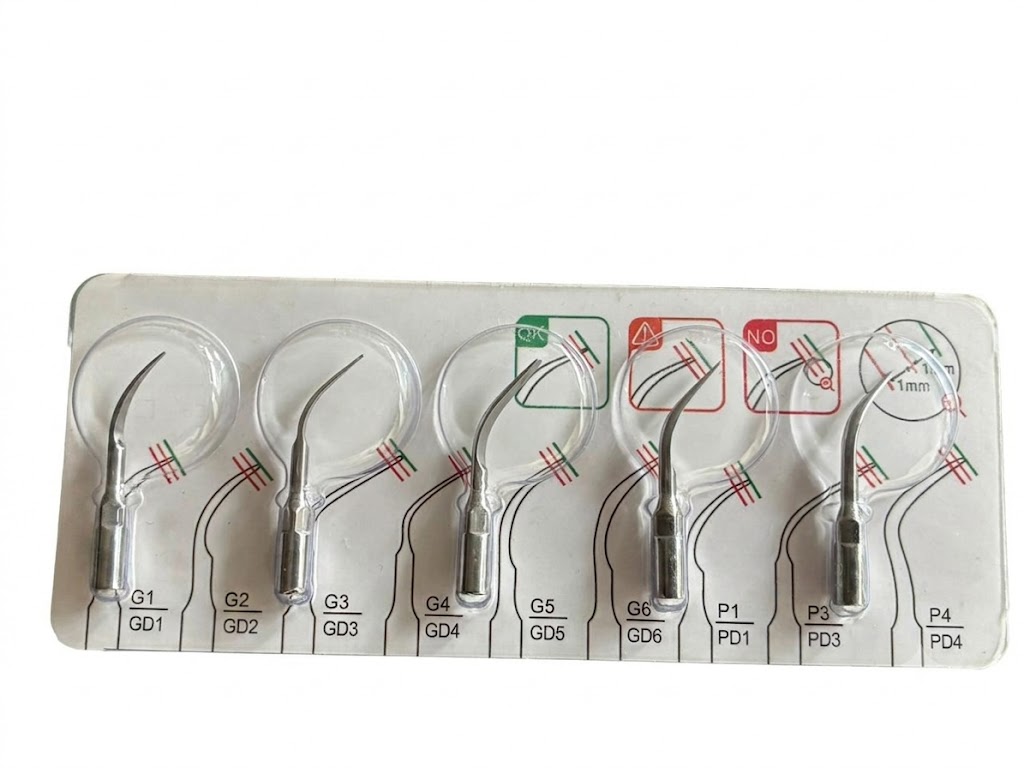
H.Zepf offers a comprehensive range of ultrasonic scaling tips compatible with major ultrasonic scaler systems. Our tips are manufactured from high-grade steel to maintain sharp, effective cutting edges through extended clinical use and repeated sterilization cycles.
Available for a wide range of clinical applications — universal scaling, subgingival debridement, and specialty procedures — H.Zepf Scaling Tips provide professional-grade performance at competitive wholesale prices.
Browse our Ultrasonic Scaling Tips, or WhatsApp us for bulk pricing and dealer enquiries.